
Sample loading with/under inert gases

Sample loading under ambient inert atmosphere or with inert noble gases address distinct challenges in diamond anvil cell (DAC) experiments:
- Sample loading under inert atmosphere prevents chemical degradation of air-sensitive samples during cell assembly and sample placement into the gasket hole.
- Noble inert gas loading, usually at high-pressure, encapsulates dense hydrostatic fluids into the sample hole;
This resource will briefly review the main techniques for preparing such high pressure diamond anvil cell experiments.Â
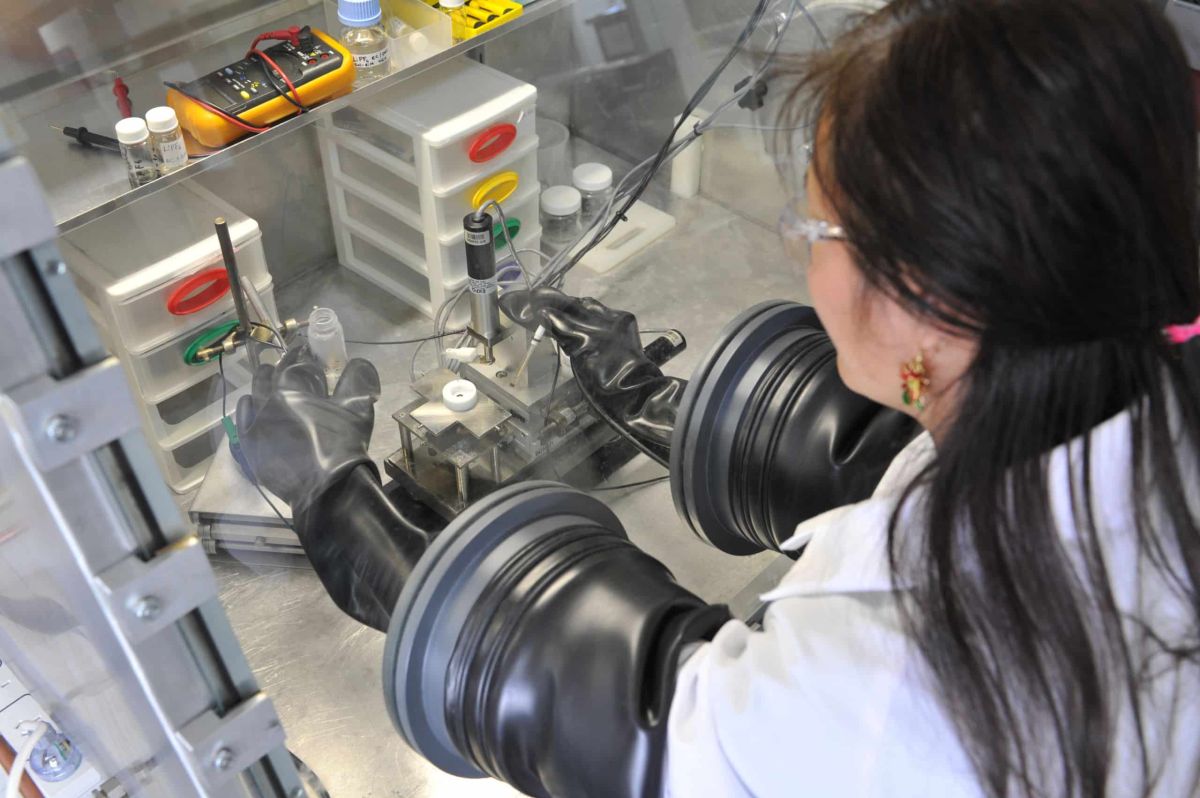
Sample Loading Under Inert Gas Environments: The Glove BoxÂ
A glove box provides a stable, low‑oxygen and low‑moisture environment that enables safe manipulation of sensitive materials. The use of a glove box protects oxygen- or moisture-sensitive samples from oxidation/degradation.
For many DAC applications, this is the most practical and widely used approach for preparing and assembling samples under inert gas such as argon or nitrogen.
Benefits
- Maintains oxygen and moisture levels typically below 1 ppm;
- Allows complete assembly of the DAC, gasket, and sample without exposure to ambient air;
- Enables safe handling of reactive, air‑sensitive, or hygroscopic compounds;
- Reduces risk of sample degradation, oxidation, or hydration.
Limitations
- Fine alignment can be more delicate due to limited freedom through gloves;
- Physical size limitations may restrict the use of larger equipment;
- Some operations—such as detailed optical alignment— still need to be performed outside the glove box.
Cryogenic gas loading in a Diamond Anvil Cell
The cryogenic gas-loading technique is a method that uses relatively simple and cost-effective cryogenic techniques wherein liquefied gas is loaded in to the diamond anvil cell.
The diamond anvil cell is placed in a cryostat or liquid nitrogen bath to drop the cell temperature below the boiling point of the target gas.
Gas introduced to the vessel condenses into a liquid inside the gasket hole, and the cell is clamped shut remotely while cold.
Benefits
- Loading Ar, N2, O2 and any other gas condensing above 77 K can be loaded into DACs;
- Small footprint equipment to be used on a lab bench;
- Ease of use with an effective cryogenic gas loading in around 15 minute.
Equipment Required:
- Cryogenic immersion vessel as the Almax easyLab Diacell® Cryoloader;Â
- Long-reach gear drives or clamping tools to close the DAC once the liquefied gas has been captured between the anvils and the gasket.
Limitations
- Requires handling cryogens;
- Managing thermal contraction of sealing hardware;
- Preventing ambient frost/water ice contamination;
- Avoiding thermal shock to the diamond anvils.

Diacell® Cryoloader
High-pressure gas loading in a Diamond Anvil Cell
High-pressure gas loading in a Diamond Anvil Cell (DAC) is a technique used in high-pressure physics and materials science to fill the cell’s microscopic sample chamber with volatile gases under high density. Common gases include:
- Noble gases (He, Ne, Ar);
- Air‑sensitive or reactive gases (H₂);
- Custom gas mixtures for specific studies.
These gases function either as hydrostatic pressure-transmitting media (PTM) or as the primary target sample being compressed.
High Pressure Gas Loader

Benefits
- Hydrostatic Pressure Environment – ensure fully hydrostatic pressure media across a wide pressure range;
- Optical & X-ray Transparency;
- Chemical Inertness;
- High-Density Gas Studies: investigate physical properties under gas-rich environments.
Limitations
- Automated high-pressure vessel with multi-stage gas boosters;
- High-vacuum pumps;
- Motorized or manual remote sealing drives;
- Compatible gas loader transmissions kits with both DACs and high pressure vessel;
- High-pressure safety shielding.
Remote Sealing Drives

The Gas Loading Process Summary
- DAC setup: The sample and pressure calibrants are positioned inside a micro-hole of a DAC that will be kept slightly unsealed.
- Evacuation & Flushing: The open DAC is placed inside a specialized chamber. To remove moist and air the chamber of the gas loader is filled and flushed with the gas few times.
- Gas loading : Gas introduced to the chamber condenses into a liquid inside the gasket hole.
- DAC Sealing: Motorized or manual gear drives remotely close the DAC inside the chamber, trapping the gas within the gasket hole.
- Recovery: The sealed DAC is extracted with the trapped gas pre-pressurized inside.
| Glovebox | Cryogenic Gas Loading | High-Pressure Gas Loading | |
|---|---|---|---|
| Application | Protect oxygen- or moisture-sensitive samples from oxidation/degradation | Load noble gases at low temperature as hydrostatic media or as primary sample | Load noble gases at near-liquid density as hydrostatic media or as primary sample |
| Pressure | Ambient pressure | Ambient pressure | 150 to 300 MPa (1,500 to 3,000 bar) |
| Temperature | Ambient temperature | Liquid Nitrogen Temperature (77 K) | Ambient temperature |
| Gases | Ar, N2 | Ar, N2, O2 | He, H2 Ne, Ar, Special mixtures |
| Complexity | Low | Medium | High |

'%3e%3cg id='Final-Copy-2_2_' transform='translate(1275.000000, 200.000000)'%3e%3cpath class='st0' d='M7.4,12.8h6.8l3.1-11.6H7.4C4.2,1.2,1.6,3.8,1.6,7S4.2,12.8,7.4,12.8z'/%3e%3c/g%3e%3c/g%3e%3c/g%3e%3cg id='final---dec.11-2020'%3e%3cg id='_x30_208-our-toggle' transform='translate(-1275.000000, -200.000000)'%3e%3cg id='Final-Copy-2' transform='translate(1275.000000, 200.000000)'%3e%3cpath class='st1' d='M22.6,0H7.4c-3.9,0-7,3.1-7,7s3.1,7,7,7h15.2c3.9,0,7-3.1,7-7S26.4,0,22.6,0z M1.6,7c0-3.2,2.6-5.8,5.8-5.8 h9.9l-3.1,11.6H7.4C4.2,12.8,1.6,10.2,1.6,7z'/%3e%3cpath id='x' class='st2' d='M24.6,4c0.2,0.2,0.2,0.6,0,0.8l0,0L22.5,7l2.2,2.2c0.2,0.2,0.2,0.6,0,0.8c-0.2,0.2-0.6,0.2-0.8,0 l0,0l-2.2-2.2L19.5,10c-0.2,0.2-0.6,0.2-0.8,0c-0.2-0.2-0.2-0.6,0-0.8l0,0L20.8,7l-2.2-2.2c-0.2-0.2-0.2-0.6,0-0.8 c0.2-0.2,0.6-0.2,0.8,0l0,0l2.2,2.2L23.8,4C24,3.8,24.4,3.8,24.6,4z'/%3e%3cpath id='y' class='st3' d='M12.7,4.1c0.2,0.2,0.3,0.6,0.1,0.8l0,0L8.6,9.8C8.5,9.9,8.4,10,8.3,10c-0.2,0.1-0.5,0.1-0.7-0.1l0,0 L5.4,7.7c-0.2-0.2-0.2-0.6,0-0.8c0.2-0.2,0.6-0.2,0.8,0l0,0L8,8.6l3.8-4.5C12,3.9,12.4,3.9,12.7,4.1z'/%3e%3c/g%3e%3c/g%3e%3c/g%3e%3c/g%3e%3c/svg%3e) Your Privacy Choices