
Different type of diamond anvil cells and their key components

The force in diamond anvil cells (DACs) can be generated through several mechanisms. The most common designs are screw-driven and gas membrane-driven systems. Other approaches include lever-arm designs, the turnbuckle principle, and elastic deflection of DAC plates using a gearbox.
The following section provides a brief overview of the operating principles for each major type of DAC commonly used in research.
Screw driven DACs
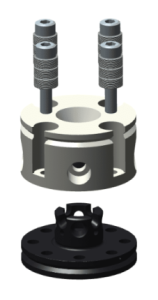
A screw-driven diamond anvil cell is the traditional design for generating high pressures. It uses mechanical screws to press the two diamond anvils together. Typically, two or more opposed screws with left- and right-handed threads apply force to the cell’s piston, thereby generating pressure between the anvils. The screws are tightened manually, often with a torque wrench.
These cells have a robust and straightforward design. However, fine pressure control can be challenging compared to gas membrane systems, as adjustments are stepwise rather than continuous. Pressure changes require manual intervention and physical access to the cell.
To improve force distribution and maintain stability, Belleville spring washers are commonly used with the screws.
Gas membrane driven DACs
A gas membrane-driven diamond anvil cell uses a flexible membrane pressurized with gas to control the applied force. As the gas pressure increases, the membrane expands and pushes the piston, bringing the two diamond anvils closer together. Common gases used for this purpose include argon and helium.
This design provides more uniform pressure application than screw-driven systems and enables remote, fine pressure control. Such features are particularly advantageous for experiments requiring precise and continuous pressure adjustments.
The key components needed for such a set up are:
- Piston – cylinder diamond anvil cell (see Diacell®Bragg-LT(G) Plus; Diacell® HeliosDAC PlusÂ
- Gas membrane;
- Gas membrane controller;
- A high pressure gas bottle and high pressure gas regulator.
Lever arm design DACs
These diamond anvil cells are based on the conventional Mao-Bell design and use a combination of lever arms and Belleville springs as a mean of exerting pressure. The diamond anvil cell is a piston-cylinder DAC. The lever-arm drive comprises two rigid arms connected to a screw through a presser plate at one end and a pressing plate linked to the DAC piston at the other. When the screw is tightened, the force—regulated by Belleville spring washers—is transmitted through the lever system to the diamond anvils, compressing the sample. The lever-arm drive can often be detached for easier integration with spectrometers or optical setups.
The Almax easyLab LeverDAC Series includes three models: the LeverDAC Mini, Maxi and Mega which respectively enable maximum pressures of 30, 50 and 100 GPa.
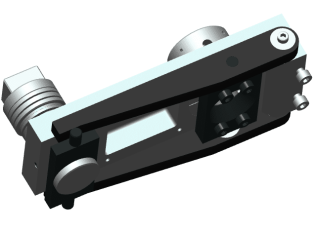
 LeverDAC Maxi – Lever Arm Driven DAC
Turnbuckle DAC : TozerDAC
The turnbuckle diamond anvil cell consists of a cylindrical body (the buckle) and two end seats (eyelets) with left- and right-hand threads, each fitted with a diamond anvil. The cell operates on the turnbuckle principle: rotating the body causes both seats to move simultaneously toward or away from each other, depending on the rotation direction.
During loading, the endcaps are secured in an external removable jig, which drives the nuts together while keeping them rotationally fixed, thus preventing damage to the sample or anvils.
The TozerDAC X-Ray is a very small cell (12 mm diameter, 11 mm height) with a compact design that makes use of both the turnbuckle principal and the conical Boehler-Almax design anvils. It can be easily accommodated in any X-ray instrument and used in conjunction with cryogenic jet coolers for use at low temperatures.
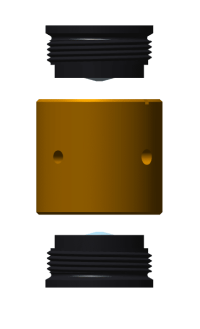
TozerDAC X-Ray
Plate Deflection DACs : PlateDAC and MegabarDAC
Most diamond anvil cells use a sliding arrangement, either of a piston in cylinder or of a plate along guide rods, to allow the anvils to move towards each other. In the Boehler-Almax PlateDAC, two steel plates accommodating the anvils are set at a fixed distance apart, and then the plates are bend to bring the anvils into contact.
The plates are held apart by pin screws toward the edge, used also for tilt adjustment, while the clamping screws, toward the centre, force the anvils together. For an easy operation the two plates are elastically deflected with the use of a driving gearbox.
The MegabarDAC uses also the principle of elastically deflected top plate in the center to apply pressure to the sample. Contrarily to the PlateDAC, in this design, the DAC components are contained into a rigid shallow cylinder where the top anvil plate has a very tight fit with the cylinder. The pressure is applied using a tight fit lid via 3 precision high pressure screws. This DAC offer maximum stability for the diamond anvils even under extreme conditions of pressure and is capable of reaching pressures above 300 GPa. Â
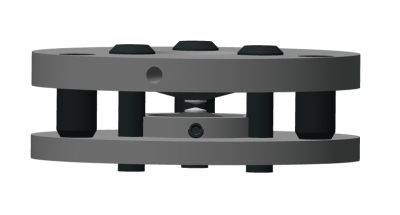
Boehler-Almax PlateDAC
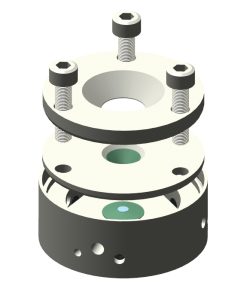
MegabarDAC

'%3e%3cg id='Final-Copy-2_2_' transform='translate(1275.000000, 200.000000)'%3e%3cpath class='st0' d='M7.4,12.8h6.8l3.1-11.6H7.4C4.2,1.2,1.6,3.8,1.6,7S4.2,12.8,7.4,12.8z'/%3e%3c/g%3e%3c/g%3e%3c/g%3e%3cg id='final---dec.11-2020'%3e%3cg id='_x30_208-our-toggle' transform='translate(-1275.000000, -200.000000)'%3e%3cg id='Final-Copy-2' transform='translate(1275.000000, 200.000000)'%3e%3cpath class='st1' d='M22.6,0H7.4c-3.9,0-7,3.1-7,7s3.1,7,7,7h15.2c3.9,0,7-3.1,7-7S26.4,0,22.6,0z M1.6,7c0-3.2,2.6-5.8,5.8-5.8 h9.9l-3.1,11.6H7.4C4.2,12.8,1.6,10.2,1.6,7z'/%3e%3cpath id='x' class='st2' d='M24.6,4c0.2,0.2,0.2,0.6,0,0.8l0,0L22.5,7l2.2,2.2c0.2,0.2,0.2,0.6,0,0.8c-0.2,0.2-0.6,0.2-0.8,0 l0,0l-2.2-2.2L19.5,10c-0.2,0.2-0.6,0.2-0.8,0c-0.2-0.2-0.2-0.6,0-0.8l0,0L20.8,7l-2.2-2.2c-0.2-0.2-0.2-0.6,0-0.8 c0.2-0.2,0.6-0.2,0.8,0l0,0l2.2,2.2L23.8,4C24,3.8,24.4,3.8,24.6,4z'/%3e%3cpath id='y' class='st3' d='M12.7,4.1c0.2,0.2,0.3,0.6,0.1,0.8l0,0L8.6,9.8C8.5,9.9,8.4,10,8.3,10c-0.2,0.1-0.5,0.1-0.7-0.1l0,0 L5.4,7.7c-0.2-0.2-0.2-0.6,0-0.8c0.2-0.2,0.6-0.2,0.8,0l0,0L8,8.6l3.8-4.5C12,3.9,12.4,3.9,12.7,4.1z'/%3e%3c/g%3e%3c/g%3e%3c/g%3e%3c/g%3e%3c/svg%3e) Your Privacy Choices